

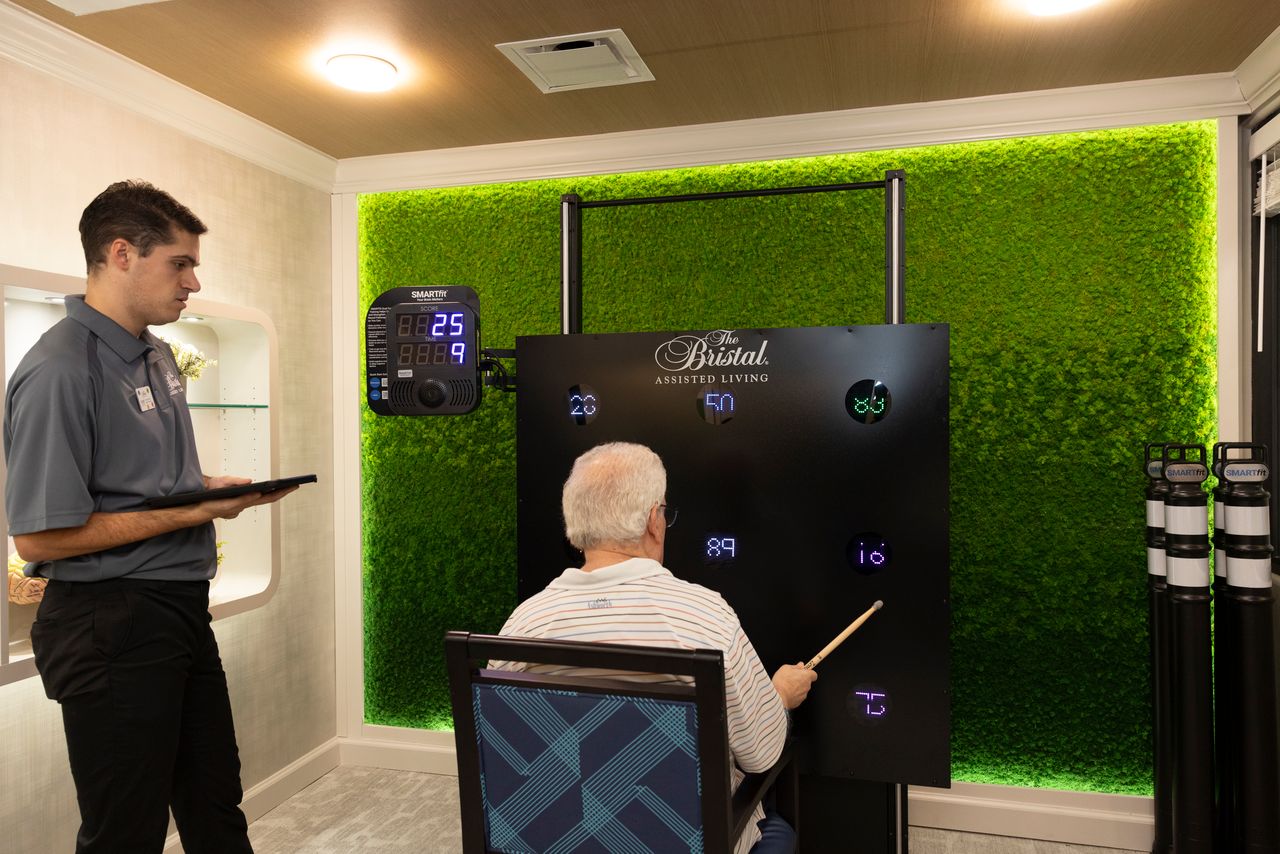
Lots of people join a gym as part of new year’s resolutions – to get their body back in shape. But, what about joining a gym for your brain? This fall The Bristal Assisted Living facility at York Avenue launched the BrainFit Gym, powered by SMARTfit cognitive wellness technology, inside its assisted living center on Manhattan’s Lower East Side.
“Our brand is innovation and diversified offerings for our residents,” said Evan Rossi, The Bristal’s corporate director of program innovation and engagement, noting that residents have shown a growing interest in brain health. Many turn to The New York Times crossword puzzle or word search for mental stimulation. “They tell me they’ve gotta keep the noggin sharp,” Rossi said. “We wanted to give our residents different ways they can engage their brain.”
The Bristal team visualized a dedicated space for health and wellness and the SMARTfit solution stood out. “We looked at quite a few technology pieces and this one appeared to be the most well-researched and well-thought-out,” he said.
SMARTfit founder and CEO Cathi Lamberti addressed the crowd at Bristal at the ribbon-cutting ceremony. “The true measure of this success is not in the technology itself, but in the impact it has on the lives of residents,” she said. “We are not just launching a new gym, we are setting a new national benchmark for health in senior living,”
What is BrainFit?
Picture a giant wall with a grid of flashing LED lights, almost like a vertical version of the popular arcade game, “Dance Dance Revolution.” Indeed, the concept is similar; both use pattern recognition, reaction time, hand-eye coordination, and some level of agility. Except instead of keeping pace with top tunes, the SMARTfit technology in a BrainFit gym is designed to strengthen cognitive skills like coordination, memory, and decision-making, which often diminish as we age.
“The SMARTfit technology is based on dual-task training, which is the simultaneous combining of cognitive training with motor training,” Lamberti explained in an interview following the grand opening. The system is adaptable to all ages and ability levels. The speed, duration, and difficulty of the challenges can be adjusted to accommodate anyone from preschoolers to elite athletes.
“If I’m training a quarterback, I’m going to put it on five-minute games with intensely physical demands,” Lamberti said.
Tasks can be completed while using weights to increase the intensity. Participants can choose to stand, sit, or even use the system with mobility aids such as a walker.

Gamification Is key
Lamberti commented on the similarity to active video games and the importance of keeping SMARTfit programs fun.
“Gamification is essential to the whole thing,” Lamberti said. “When you get caught up in a game, a part of your brain switches on at a higher level. The entire endocrine system gets a lift. That higher level executive function, with a drive to do well, is like steroids for the brain.”
At the ceremony, residents demonstrated the equipment’s capabilities to media and staff. Then, many of us got a turn on SMARTfit system. I stepped inside the glass-walled room and took the drumstick-like controllers in my hand. I felt that mild adrenaline rush of competition that Lamberti referenced kick in. I hit the illuminated targets as a small crowd watched and cheered me on. I imagined how the seniors must enjoy the sense of camaraderie and the boost that comes from supporting each other, not to mention the feeling of success from achieving a personal best score. Residents who are driven by competition might even enjoy trying to beat their friends’ scores.
Lamberti confirmed my suspicions. “We have small group training and large group training. And that is a riot. I’ve seen husbands and wives go at it,” she said with a laugh.
During my session, the game got tougher in round two. Instead of hitting colored lights, I had to find and hit the letters of the alphabet in order. When I finished with time to spare, I was charged with doing the task backward. Alas, I ran out of time. These short bursts of activity fly by and feel as if they are over just as you’re getting started. The Bristal staff member said I had the second highest score of the day, which impressed me given the wide range of ages who had demo’d the system. I guess even at 50+ and in the throes of perimenopause, my memory functioned better than I expected.
“True dual-task, cognitive-motor training that focuses on executive function – decision-making – is proven to transfer to activities of daily living. ” – SMARTfit founder and CEO Cathi Lamberti
Transferable skills
Studies posted on the SMARTfit website indicate that if I played these cognitive games regularly, I could see improvements in not just memory, but processing speed, executive functioning, and attention – skills that are especially important to keep sharp as we age. That’s the beauty – and the importance — of this technology for assisted living residents.
“True dual-task, cognitive-motor training that focuses on executive function – decision-making – is proven to transfer to activities of daily living,” Lamberti explained. “The key with any training is you want transference to real life.”
One recent peer-reviewed study published in Frontiers in Sports and Active Living found that dual task “exer-gaming” programs produced greater benefits that training the brain and body separately. Another study published in the Journal of Aging and Physical Activity shared that SMARTfit’s dual-task training, shows the “potential to enhance executive function in older adults with mild cognitive impairment.”
Why it works
Lamberti explained the reason dual-task training works; it’s rooted in 250,000 years of biology. “For over 250,000 years, in order to survive, we had to address a problem, plan, make a decision for a solution, and then execute with our motor system using our skills,” she said.
This top-down, executive-function training sets SMARTfit apart from other systems that focus exclusively on reaction training, or what Lamberti called “bottom up” training.
“In bottom-up training, you see and react. The SMARTfit system has a lot of reaction training in it. You see a colored light, you hit the blue one, not the red one,” she said. “Reaction training is important; it can stop you from falling when you trip.”
But the addition of top-down training, which incorporates problem-solving, pattern-recognition, and planning, transfers to activities of daily living and cognitive performance.
“When you train the brain this way, you sharpen the mental processing and physical execution so you can do skills of any kind,” she said.
A big ‘hit’ with the grandkids, too
Rossi said The Bristal seeks to prioritize intellectual wellness, physical offerings, and social interaction. He knew the BrainFit gym would check all these boxes. But he was pleasantly surprised by the reactions from the younger generations.
“The adult children are seeing the commitment we have to their parents’ brain health. They almost care more than the residents. And they want to play on the machines,” he said.
It also makes visits to the community easier for the sandwich generation, who may bring their younger children or teens to see their grandparents or great-grandparents. “The grandchildren come into the facilities on the weekends and want to play,” Lamberti said. “It motivates them to see grandma and grandpa.”
It took decades to get here, but gaming may be the common language that connects generations. And if cognitive decline is the ultimate opponent at the end of the game, dual task training via SMARTfit may be a powerful tool to fight it.
More from Nifty50+
- Home-Based Care vs. Assisted Living: Pros and Cons
- Can you wish your way into better finances? An expert weighs in
- What are the best years of your life? A study on what older adults say may surprise you
- Why the death of a beloved pet hits hard for older adults