

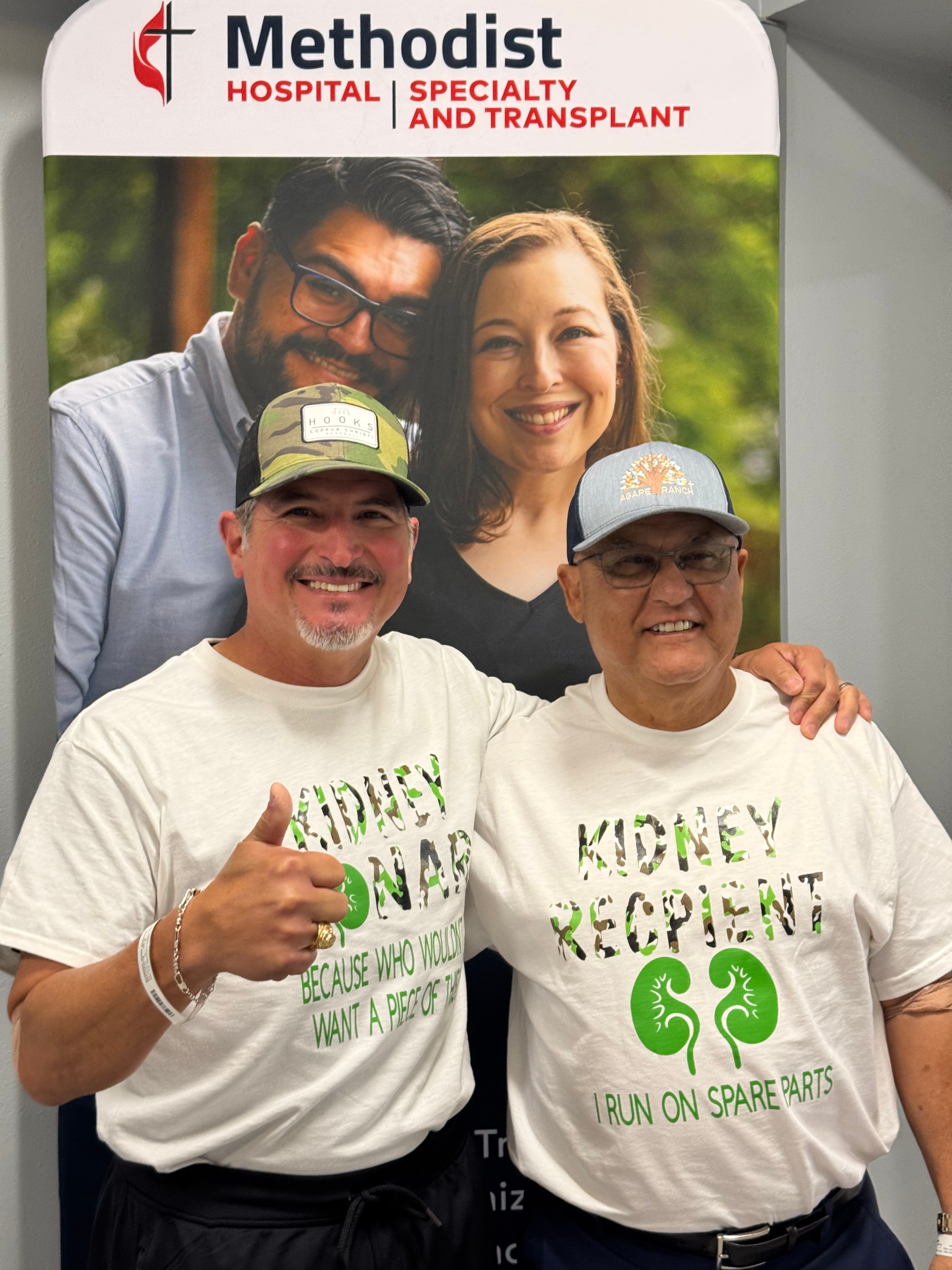
Twenty-five years ago, Rudy Vasquez was running an athletic training facility in San Antonio, Texas, when Nick Alvarado drove up in what Vasquez jokingly calls a “ratty old truck” belonging to someone he thought “might be related to Fred Sanford.” Alvarado, a San Antonio native, had been living in Houston, but “gravitated toward home” to finish his education. He also needed a job to support his wife and young family. Vasquez had Alvarado teach a baseball lesson to one of the kids at the training center and the job was his.
Read: More helpful health stories
Discover: How Your Hair Reflects Heart Health and Aging
The two men bonded over their love of the sport of baseball with Vasquez, now 69, assuming the role of an older brother, mentor figure to Alvarado, 56. Vasquez, who in recent years has embarked on a second career as a real estate agent, would go on to become a talent scout for Major League Baseball (MLB) and Alvarado, a longtime high school baseball coach, now works in education administration.
Although the two close friends would go for stretches of time without communicating, Alvarado says, “Every time the Lord needed us to talk, we would always speak at the right time.” Their conversations revolved around their families and their shared love of baseball.
The call that changed their lives
On August 26, 2025 – both men clearly recall the exact date – Alvarado was in his first year as a school administrator and, after three days of intensive training, was preparing to give a presentation when his cell phone lit up with a call from Vasquez, who explained that his kidney disease had progressed to the point that he needed a transplant and asked for prayer. (Vasquez didn’t want to undergo dialysis and wasn’t a candidate for tissue donation.)
Keeping an eye on the clock as the time for his presentation approached, Alvarado immediately said, “I’ll give you a kidney; I’ve got a couple of them.” At the same time, he says, “I felt like I was in a vacuum; everything just went silent and the words came out of my mouth.”
“It was a godsend,” Vasquez says. “There’s nothing else to say,” particularly as Vasquez’s wife, Tricia, his adult children with his late first wife, and a niece had all been ruled out as donors, along with a friend he had known since they were teenagers whose “wife was not onboard.”
Alvarado’s wife, Kristi, on the other hand, told him, “The journey didn’t start August 26th – it was written for eternity – but it started with your earthly relationship [25 years ago].”
As a father of four (his two children and two stepchildren), and a grandfather of seven, Alvarado says the only question that came up was, what if one of the kids ever needed a kidney?
“What if you hold out for a gift like that [in a situation] that never materializes and you miss out on an opportunity to help?” Alvarado asks.

Rudy Vasquez’s journey
In the decade or so leading up to this moment, Vasquez’s doctors first noticed excessive protein in his urine during routine blood work, which they began monitoring. In his mid-50s at the time, Vasquez advice is succinct: “Get checked sooner rather than later.” He also points out that he had no physical symptoms leading up to the discovery of protein in his blood. “I looked good, I felt good; there was no pain.”
He also wasn’t diabetic and didn’t have a family history of kidney disease (both of which are risk factors). However, he did have high blood pressure, known as the “silent killer,” often due to a lack of symptoms until it has already caused serious damage, such as a heart attack, stroke or kidney damage. Vasquez is honest in admitting that he didn’t take the prescribed medication and acknowledges, “That probably contributed to the decline in my kidney function.”
Last year, his nephrologist told him that he had stage 4 kidney disease, bordering on stage 5, and that it would only be a year or two before he would have to start thinking about dialysis or the possibility of a transplant. The call with Alvarado came at just the right time, but there was still the question as to whether he was a match.
Testing and More Testing
Alvarado likens the eight-page, detailed questionnaire to help determine eligibility to “a college entrance exam to make sure you really want to do this,” followed by extensive blood work to measure the donor’s own kidney function and ensure compatibility with the recipient. When he was told, “You’re a match,” he says he was “guardedly optimistic,” as there were still numerous tests that needed to be done over the period of time leading up to their surgeries.
Vasquez says his experience as the recipient “mimicked and mirrored Nick’s” with extensive testing to make sure he was “strong enough to receive this gift of life.”
Eventually, a final compatibility test was conducted to establish that Vasquez hadn’t built up antibodies to the crossmatching, where his blood and Alvarado’s had been mixed to ensure Vasquez’s antibodies wouldn’t attack Alvarado’s kidney once it was transplanted. The men were then given the all-clear and a surgery date was set for December 30, 2025, at Methodist Hospital in San Antonio, where their surgeries would take place side by side. After about two and a half hours, Alvarado was in recovery and says he was cracking jokes with the medical team.
As the recipient, Vasquez’s surgery lasted an additional two and a half hours or so, but he says, “My body noticed an improvement almost as soon as the anesthesia wore off. I felt stronger, more energetic.” Less than three months post-surgery, he says he feels over 90% better and is “dancing around the house.”
Ultimately, Alvarado believes his faith compelled him to donate his kidney to Vasquez, but he says, “The human side of it is we’re here on this earth to help others. It’s got to be something you feel moved to do.”
Ever mindful that he has been given a life-saving gift as a result of his friend’s act of selflessness, Vasquez says, “Our health is our greatest earthly wealth.”
March is National Kidney Month. For more information, visit the National Kidney Foundation.
More from Nifty50+
- Americans agree on politics more than you think — just not with these people
- How Your Hair Reflects Heart Health and Aging
- From Florida to NY – 7 great places to travel with extended family
- Challenges of caring for elderly family add up; get expert tips to help